Food / chilled and frozen labels
Central kitchens, food factories and cold-chain logistics; product name, expiry date, nutrition and batch labels that often go into fridges or freezers.
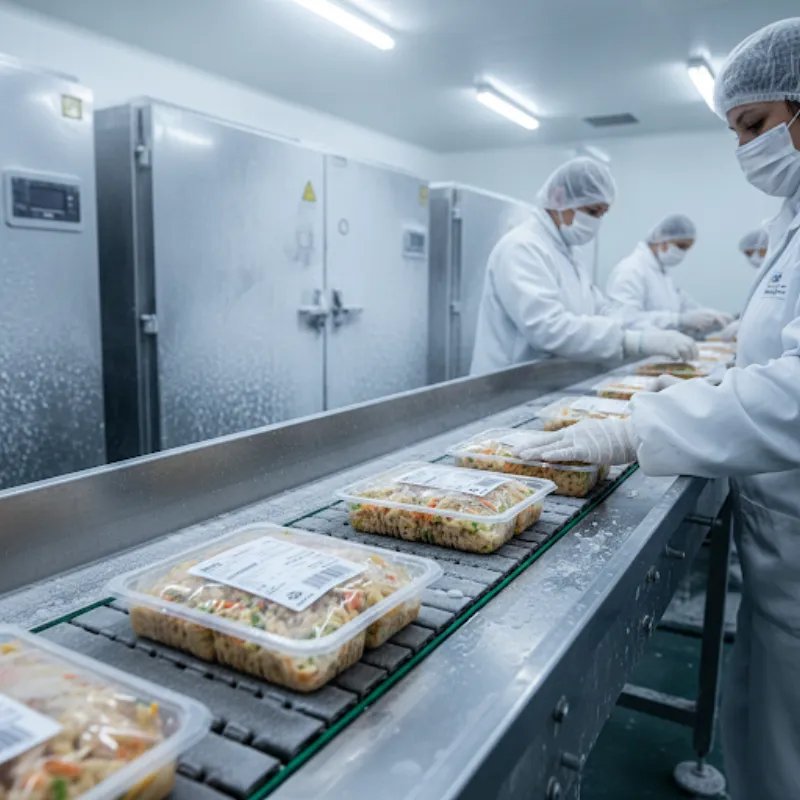
Recommended combinations
| Situation | Label material | Ribbon type | Adhesive |
|---|---|---|---|
| Room temperature, chilled | Coated paper or thermal paper | Wax (not needed for thermal paper) | Standard permanent |
| Frozen, frost on the surface | Coated paper or synthetic paper (PP / PE) | Wax or wax-resin | Freezer adhesive |
| Damp, gets wet | Synthetic paper (PP / PE) | Wax-resin | Freezer adhesive |
Recommended combinations are general guidance; always confirm with a test print.
Why this combination
Ordinary adhesives harden and lose tack at low temperatures, so labels fall off. Freezer adhesives keep their tack in the cold. Synthetic paper is water-resistant and won't break down from condensation when moved in and out of the fridge.
Common sizes
60×40 mm, 70×50 mm, 80×60 mm, 100×70 mm (for longer nutrition panels).
What to watch out for
- Adhesives have two temperatures: the "minimum application temperature" and the "service temperature range" after application—they are different. Many freezer adhesives must be applied at room temperature before freezing and don't stick well to frosted surfaces; actual temperatures depend on the material spec.
- Thermal paper is sensitive to heat and oil; for greasy packaging, choose top-coated thermal paper or switch to thermal transfer.
- If the label will directly contact food, the material must be checked separately for food-contact compliance.
- Food labeling content follows health regulations; please check it yourself.
Not suitable for
For blast freezing, ultra-low temperature freezers and -196°C liquid nitrogen, see: Low-temperature labels
Information to include in your inquiry
- Printer brand and model (or "haven't bought one yet")
- Label width × height (mm), labels per roll or total quantity needed
- What surface it goes on (carton, plastic, metal, glass, fabric…)
- How long the label must last and what it will be exposed to (freezing, water, alcohol, sunlight, heat…)
- Photos of the labels or ribbons you use now (if any)
- The lowest temperature (chilled / frozen / blast-frozen), whether the label is applied before freezing or onto already-frozen items, and the packaging it goes on.
Which printer do you use? Write the model in the inquiry form and we will check that the sizes and ribbon fit. If you already have specs, you can also enter label specs or ribbon specs directly.
Other applications
Shipping / logistics / carton labelsProduct / part number / barcode labelsAsset / Equipment labelsFabric / care labelsChemical GHS labelsOutdoor / weather-resistant labelsElectronics / semiconductor / cleanroom labelsJewelry / small tag labelsWarehouse / shelf labels (removable)Pallet / large-format labels